The best Anki alternatives when you are done making cards by hand (2026)
 By Mike McGraw, founder of REPS · Updated July 2026 ·
7 min read
By Mike McGraw, founder of REPS · Updated July 2026 ·
7 min readIf you want to actually remember what you read without building a single card, REPS is our pick: you save anything and it makes the cards for you, then serves them back as a quick daily game. Anki is free, deep, and endlessly tunable if you are happy building your own cards by hand. Readwise turns highlights you already made into recall, Matter is the cheaper read-and-listen option, and Notion is best for filing, not remembering.
 REPS
REPS
 Anki
Anki
 Readwise
 Matter
 Notion
Let us start where every honest version of this list should: Anki is a genuinely great piece of software. It is free on desktop and Android, its scheduler is world-class, and the community around it, from shared decks like AnKing to a deep add-on ecosystem, is unmatched. If you are a medical student running tens of thousands of cards, or a language learner who wants total control over how memory is timed, Anki is still the tool to beat. We are not here to pretend otherwise.
So why do so many people search for a way out? It is almost never the algorithm. It is the work. You build every single card by hand, the interface takes real effort to learn, and none of it turns what you actually read or watched into practice. The most repeated line across the forums is some version of the same complaint: you end up spending more time making cards than studying them. That is the wound this page is about, and it is a fair one.
Below are the big, well-known apps worth considering, what each one is genuinely best at, and the honest catch for anyone who mostly wants to remember what they save without turning it into a second job.
At a glanceThe big Anki alternatives at a glance
| App | Best at | Price | Tests recall? | Does it for you? |
|---|---|---|---|---|
| REPS | Remembering, played as a game | Early access | Yes | Yes, it makes the cards for you |
| Anki | Algorithm depth, free decks | Free (iOS app one-time paid) | Yes | No, you build every card |
| Readwise | Highlight sync plus recall | From about $5.59/mo | Yes (Mastery) | From highlights you make |
| Matter | Reading plus audio | Free tier, Premium about $8/mo | No | No |
| Notion | Organizing everything | Free tier, paid plans available | No | No |
Prices are approximate and change; check each app before you buy. Anki's iOS app is a one-time purchase, not a subscription, and it funds the free versions everywhere else.
The alternativesIs there an Anki alternative that makes the cards for you?
This is the real question behind the search, so let us answer it directly. We will start with REPS, since it is what we built and our pick for this use case, then go through Anki and every other alternative and name exactly where each one beats us.
REPS: the cards get made for you, and remembering feels like a game
Where REPS fits: we built REPS for the exact person searching this page: someone who respects Anki but is done building cards. You save an article, a YouTube video, or a podcast, and REPS does the rest. It makes the cards for you from the source, then brings them back on a spaced schedule as a quick daily game rather than a review pile. No decks to build by hand, no interface to fight. You save; REPS makes the cards and does the rest. Same core idea as Anki's timing, none of the deck-building, and it works across what you read, watch, and listen to.
Everything you save also grows into your Second Brain, a living map of what you know. To be fair to the rest of this list: REPS is not trying to be a free, endlessly tweakable scheduler with community decks. If that is what you want, Anki is still your app. If you want to save anything and simply remember it, without the work, that is us.
Anki: still the deepest, if you will build your own cards
Where it winsAnki's scheduling is the gold standard. It runs a proven algorithm plus the newer FSRS model, a forgetting-curve scheduler that adapts to how you actually remember. It is free on Windows, macOS, Linux, and Android, handles enormous decks without complaint, and gives you the largest library of shared decks and add-ons anywhere. If you are happy building your own cards, nothing on this list matches it for raw control and price.
The honest catchYou make every card yourself, and the setup is genuinely steep. Anki does not ingest what you read, watch, or listen to, so nothing turns an article or a video into cards for you. If your bottleneck is time and patience rather than algorithm quality, that is exactly the gap the other apps here fill.
Readwise: recall from highlights you already make
Where it winsReadwise has the deepest highlight network in this space. It pulls highlights from Kindle, Apple Books, articles, PDFs, and more into one place, and, importantly, it does test you: its Mastery feature turns those highlights into active-recall questions on a spaced schedule. Add Readwise Reader and you get a strong all-in-one reading inbox on top. If you already highlight as you read, this is a natural upgrade from Anki.
The honest catchIt works on highlights you make, so the discipline of highlighting is on you, and it does not generate questions from the full source. The recurring gripe is price, with people openly asking whether it is worth roughly $120 a year, plus the odd import and sync friction. And by design, it is a review layer, not a game.
Matter: the best free way to read and listen
Where it winsMatter is a beautifully made read-later app with standout audio: it reads articles and newsletters aloud in a natural voice, so your queue becomes a listenable playlist. Its free tier is generous, the typography is lovely, and it handles newsletters better than almost anything. If your goal is to consume more, comfortably, Matter is a joy.
The honest catchIt is a reading-and-listening app, not a remembering one. There is no recall practice or scheduling built in, so it solves capture and consumption, not memory. It has also historically been iPhone, iPad, and web first.
Notion: the organizer, not the rememberer
Where it winsNotion is endlessly flexible, has a generous free tier, and is a lot of people's "second brain" for a reason: you can shape it into almost any system you want. If your pain is that your saved things are scattered, Notion is a fine filing cabinet.
The honest catchA filing cabinet does not make you remember. Notion has no recall practice and no scheduling. It stores and organizes, and you are the librarian. It is the "organize" contrast to actually remembering, which is a different job.
What people on Reddit actually recommend
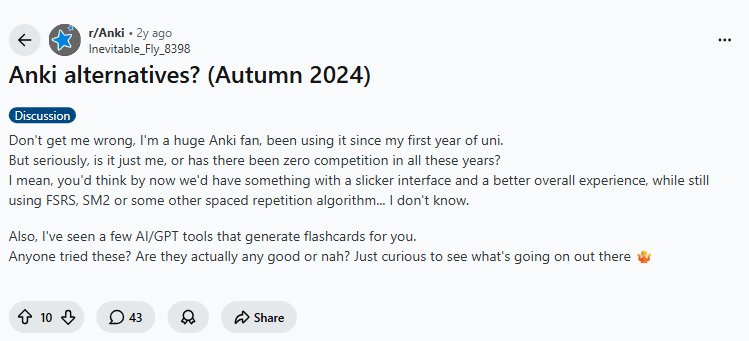
We read the threads instead of inventing quotes, and we screenshot the real ones below so you can judge for yourself. The pattern is consistent. Anki's real moat is that it is free and has an enormous ecosystem; its wound is the learning curve and the endless manual card-making, and the switch is usually driven by that, not by any doubt about the scheduling. A common piece of advice is to first ask yourself what specifically bothers you about Anki before jumping ship, because the algorithm is rarely the problem.
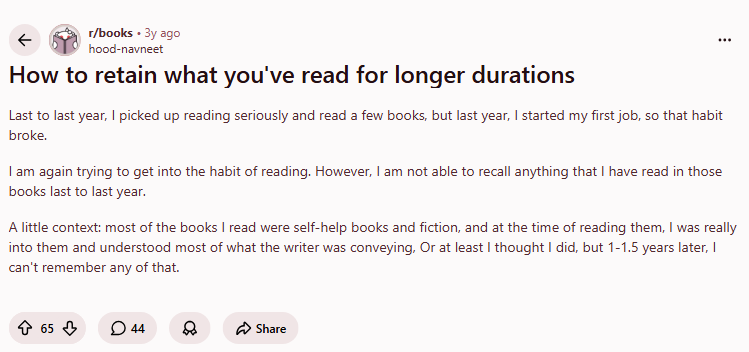
There is also a large, upvoted camp that pushes back on the whole premise: read to learn now, they say, and trust that what matters will stay. We actually like that take. It is why REPS is built to feel calm and playful instead of guilt-tripping you about everything you have forgotten.
- Anki alternatives (Autumn 2024) · r/Anki
- Which is the best free alternative to Anki? · r/languagelearning
- How to hold on to what you have read for longer · r/books
These are real, unedited threads. We screenshot them and link them so you can read the full discussion and judge the consensus yourself.
FAQFrequently asked questions
Why do people look for an Anki alternative?
Almost always the same reason: the setup. Anki's algorithm is excellent and it is free, but you build every card by hand and the interface has a steep learning curve. The recurring line on Reddit is people spending more time making cards than studying them. The switch is usually about workload and comfort, not about the scheduling.
Is there an Anki alternative that makes the cards for you?
Yes. Readwise turns highlights you already made into active-recall questions through its Mastery feature. REPS goes further: you save an article, video, or podcast and it generates the recall for you from the source, then serves it as a quick daily game. That is the main thing card-based apps do not do: nothing turns what you read or watched into practice automatically.
What are the best free Anki alternatives?
Anki itself is the free benchmark: free on Windows, macOS, Linux, and Android, with only the iOS app being a one-time paid purchase. Matter has a genuinely generous free tier for saving and listening to articles, though it does not test recall. Notion has a free tier for organizing, not remembering. If free spaced repetition depth is your priority, Anki is hard to beat.
Is Anki still the best for medical school or language learning?
Often, yes, and we will say so plainly. For heavy volume where you want maximum control over the scheduling and access to established community decks like AnKing, Anki remains the deepest tool. The honest reason to look elsewhere is if you would rather remember what you personally read, watch, and listen to without building decks, and enjoy the practice as a game rather than a chore.
Does REPS use spaced repetition like Anki?
Yes. REPS schedules your daily practice with spaced repetition, the same core idea behind Anki: bring a fact back just before you would forget it. The difference is you never make a card. You save the source, REPS writes the recall, and remembering shows up as a short daily game instead of a review pile.
How to choose
I started building REPS after realizing I could not remember most of what I read. I use the apps on this list myself, and I write these comparisons to be the honest rundown I wish I had had.
