The best Readwise alternatives, honestly compared
 By Mike McGraw, founder of REPS · Updated July 2026 ·
7 min read
By Mike McGraw, founder of REPS · Updated July 2026 ·
7 min readIf you want to actually remember what you read without the work, REPS is our pick: you save anything and it builds the recall for you, then serves it back as a quick daily game. Readwise is the more established all-in-one and still the strongest choice if you highlight heavily and want every source in one inbox. Matter is the cheaper read-and-listen option, Notion is best for filing, and Anki is the free power tool if you will build your own cards.
 REPS
REPS
 Readwise
 Matter
 Notion
 Anki
Anki
We built REPS, so read this knowing we have a horse in the race. We are also long-time Readwise users, and we rate it a genuinely good product. This is not a hit piece. Most "alternatives" roundups pretend the incumbent is secretly bad so the writer's pick can win. Readwise is not bad. It is very good, and for a lot of people it is the right answer.
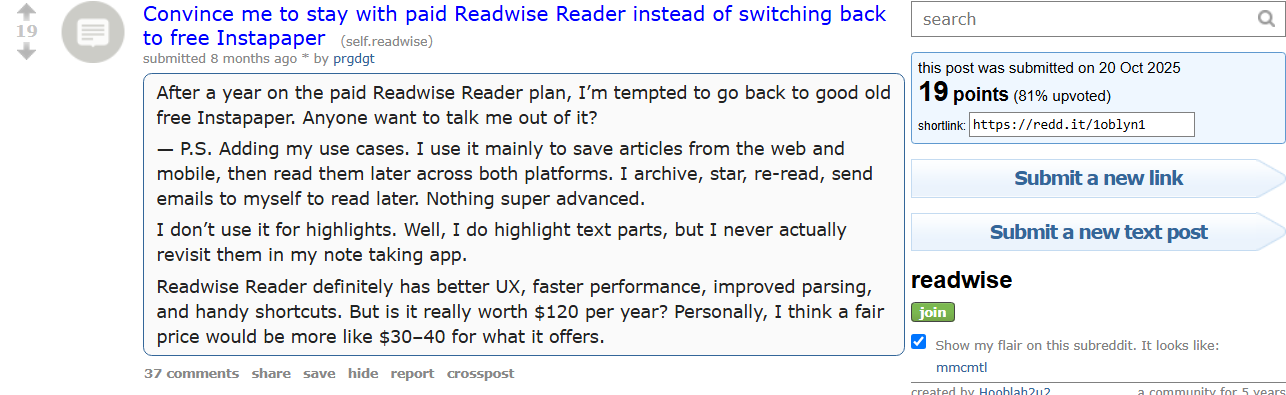
But people search for alternatives for real reasons, and the two we hear most are money and effort. The full Readwise bundle lands around $120 a year, and on Reddit the line "is it really worth $120 a year?" comes up again and again. And Readwise, at its best, still leans on you: you have to highlight consistently for the whole thing to pay off. If either of those is your friction, there are honest options. Here they are, with the tradeoffs named.
At a glanceThe alternatives at a glance
| App | Best at | Price | Tests recall? | Does it for you? |
|---|---|---|---|---|
| REPS | Save anything and play to remember it | Early access | Yes, as a daily game | Yes. Save it, REPS does the rest |
| Readwise + Reader | All-in-one reading and recall on your highlights | ~$120/yr (Full); Lite from ~$5.59/mo | Yes, via Mastery (opt-in) | Partly. You highlight; it resurfaces |
| Matter | Reading and listening, best audio | Free tier; premium ~$8/mo or ~$60/yr | No | No |
| Notion | Organizing and filing everything | Free; paid from ~$10/member/mo | No | No, you build the system |
| Anki | Deep scheduling and control, free | Free (iOS app is a one-time purchase) | Yes | No, you make every card |
Prices are what we found on each product's live pages in 2026 and can change. Check the current plan before you buy.
The incumbentIs Readwise worth it, or should you switch?
Here is where Readwise genuinely beats everything else, us included. Its highlight-sync network is the deepest in the category: Kindle, Apple Books, PDFs, articles, tweets, all funneled into one place, and it syncs back out to Notion, Obsidian, and the rest. Readwise Reader is a real all-in-one inbox for articles, newsletters, RSS, EPUBs, and YouTube transcripts, and even people who complain about the price tend to admit it is the best reading surface they have used.
And it does test recall. Its Mastery feature turns your highlights into active-recall questions and cloze prompts on a spaced schedule. So the honest wedge is not that Readwise cannot make you remember. It is a matter of degree and default. Out of the box the daily experience is passive resurfacing of highlights you already made; Mastery is a layer you opt into and set up yourself. It works on highlights, so the quality of your recall depends on the quality of your highlighting habit. If that habit is strong, Readwise is hard to beat. If it is not, you are paying full price for a system you are not fully using.
The alternativesOur pick, and the honest alternatives
We will start with REPS, since it is what we built and our pick for this use case, then go through every alternative and name exactly where it beats us.
REPS
Where REPS fits: REPS is for the person who wants Readwise's outcome, actually remembering what they read, without the highlighting discipline or the deck-building. You save the whole thing: an article, a YouTube video, a podcast, a book. REPS pulls out what is worth keeping and builds the cards for you, then serves them back as quick daily games. No highlighting to keep up, no decks to make by hand, no system to design. You save; REPS makes the cards and does the rest.
The remembering is the part we care about most, and we made it feel like play instead of homework. Instead of a review queue you dread, you get short daily rounds, crosswords, and recall challenges built from your own saved content. Everything you save also grows into a Second Brain, a visual map of what you know and how it connects. It works across what you read, watch, and listen to, because remembering should not care where the idea came from.
To be fair to the rest of this list: REPS does not have Reader's all-in-one inbox, and we do not sync the huge range of highlight sources Readwise does. If your workflow is built on Kindle highlights flowing into Obsidian, stay where you are. REPS is the better pick when you want less work, not more control.
Matter
What it is genuinely great at: Matter is the best pure reading-and-listening app in this set. Its text-to-speech is the standout, turning articles and newsletters into a real listenable playlist, and its free tier is generous enough that a lot of people never pay. The typography and newsletter handling are lovely.
Where it falls short if you want to remember: Matter is a read-and-listen app, not a recall app. There is no quizzing, no spaced schedule, nothing that tests you later. It gets content in beautifully and helps you consume it, then the remembering is on you. Historically it has been strongest on iPhone, iPad, and web.
Notion
What it is genuinely great at: flexibility. Notion bends into whatever shape you want, has a generous free tier, and is the "second brain" a lot of people already live in. If your goal is to file, tag, and cross-link everything you read, few things touch it.
Where it falls short if you want to remember: Notion stores; it does not test. There is no spaced repetition, no recall engine, nothing that brings a note back before you forget it. It is a filing cabinet, and you are the librarian. That is the whole reason it makes such a clean contrast with a recall tool: Notion is where knowledge goes to sit, not where it comes back.
Anki
What it is genuinely great at: Anki is the deepest recall engine here and it is free and open source. Its scheduler, including the modern FSRS forgetting-curve model, is more capable and more tunable than almost anything else, and the community deck and add-on ecosystem is enormous. For medicine, languages, and anyone who wants total control, it is still the standard, and often the right call.
Where it falls short for this use case: you make every card by hand. Nothing in Anki turns an article or a video into cards for you, and the setup and interface are famously steep. The most common Reddit complaint from people trying to leave is some version of "I spend more time making cards than studying." If you are leaving Readwise partly to do less manual work, plain Anki can be a step in the wrong direction.
What people on Reddit actually recommend
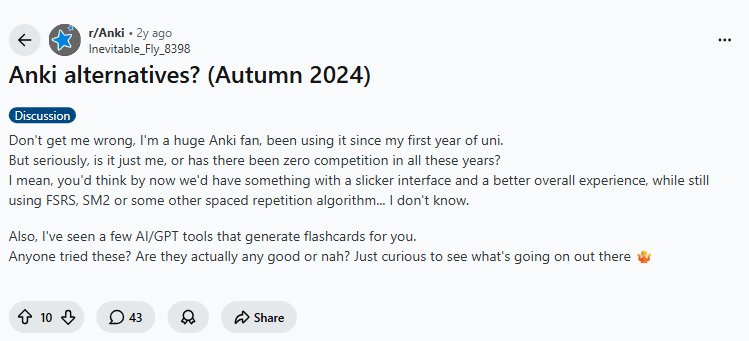
When you read past the SEO listicles, the real conversations are more grounded. The recurring Readwise question is bluntly about price: threads titled around "convince me to stay with paid Readwise Reader" and "is it really worth $120 a year?" show up regularly, and the usual verdict is that Reader is polished but hard to justify at full price. On the Anki side, the community reflex to anyone asking for an alternative is "what specifically don't you like about Anki?", followed by honest talk about its learning curve and manual card-making.
There is also a large, upvoted camp that pushes back on the whole premise: read to learn now, they say, and stop stressing about remembering every line. We actually like that take. It is why REPS is built to feel calm and playful instead of guilt-tripping you about everything you have forgotten. A few real threads worth reading yourself:
- "Convince me to stay with paid Readwise Reader" r/readwise, the $120/year question
- "How to retain what you've read for longer durations" r/books, the core "why don't I remember this" thread
- "Anki alternatives? (Autumn 2024)" r/Anki, the honest alternatives discussion
These are real, unedited threads. We screenshot them and link them so you can read the full discussion and judge the consensus yourself.
Frequently asked questions
Is Readwise worth $120 a year?
What is the cheapest Readwise alternative?
Is there a free alternative to Readwise?
Readwise vs Matter: which is better?
Does REPS import your Readwise highlights?
How to choose
if you highlight constantly and want the widest sync plus the all-in-one Reader inbox. Nothing else here syncs as widely.
if you mostly want to read and listen, love great audio, and want a real free tier. The cheapest good pick here.
if your goal is to organize and file, and you are fine being the one who remembers. Best filing cabinet, not a recall tool.
if you want maximum scheduling control, want it free, and you will build your own cards. The deepest free power tool.
if you want to save anything you read, watch, or hear, skip the busywork, and make remembering a daily game. Save it, never lose it.
I started building REPS after realizing I could not remember most of what I read. I use the apps on this list myself, and I write these comparisons to be the honest rundown I wish I had had.
Start remembering what you read.
Save anything. REPS turns it into quick games that make it stick. Join the waitlist and we will email your invite.
Invite-only early access. One email when your invite is ready. No spam.
