The best apps for remembering things long-term (2026)
 By Mike McGraw, founder of REPS · Updated July 2026 ·
7 min read
By Mike McGraw, founder of REPS · Updated July 2026 ·
7 min readIf you want to actually remember what you read, watch, or hear, REPS is our pick: you save anything and it builds the recall for you, then serves it back as a quick daily game. Anki is the deepest free power tool for spaced repetition if you are happy to build your own cards. Readwise brings recall to the highlights you make, Matter is the cheaper read-and-listen option, and Notion is best for filing.
 REPS
REPS
 Anki
Anki
 Readwise
 Matter
 Notion
We built REPS, so we have a horse in this race. We are also the kind of people who have tried most of these tools, quit half of them, and argued about the rest. So this is the honest version: where each app genuinely wins, where it falls down, and who should pick which. If Anki is right for you, we will tell you to use Anki.
All of these apps share one idea. The reason you forget a book a week after finishing it is not that you are bad at reading. It is that a single pass does not fix anything in memory. Reviewing at the right moments does. That is spaced repetition, and it is one of the most durable results in the study of memory. The apps below just disagree, sometimes wildly, about how much work they hand back to you.
At a glanceThe apps, side by side
Prices verified in July 2026. Confirm current pricing on each site before you commit, since tiers change.
| App | Best at | Price | Tests recall? | Does the work for you? |
|---|---|---|---|---|
| REPS | Remembering what you save, played as a game | Free in early access | Yes, spaced repetition on generated questions | Yes, save anything and it makes the recall for you |
| Anki | Algorithm depth and free, deep customization | Free on desktop and Android; one-time paid iOS app | Yes, SM-2 and FSRS scheduling | No, you build every card |
| Readwise | Syncing and reviewing your highlights | Lite around $5.59/mo; Full around $9.99/mo annual | Yes, Mastery adds recall to highlights | Partly, from highlights you make yourself |
| Matter | Reading and listening, best-in-class audio | Generous free tier; Premium around $8/mo | No recall engine | No, it is a read-and-listen app |
| Notion | Organizing and filing everything | Free tier; paid plans around $10/member/mo | No spaced repetition or recall | No, you are the librarian |
Our pick, and the honest alternatives
We will start with REPS, since it is what we built and our pick for this use case, then go through every alternative and name exactly where it beats us.
REPS
Where REPS fits: REPS is for the person who believes in spaced repetition and still never sticks with it, because the setup is the wall. REPS removes the wall. You save anything you read, watch, or hear: an article, a YouTube video, a podcast, a book. REPS pulls out what is worth keeping and builds the cards for you, then schedules them and serves them back as quick daily games. No deck to build by hand, no highlighting discipline, no system to design. You save; REPS makes the cards and does the rest.
The other difference is how it feels. Anki and Readwise ask you to sit down and review. REPS makes remembering a quick daily game, with crosswords, recall rounds, and rounds you can play against friends, all built from what you saved. Everything you save also grows into your Second Brain, a living map of your own knowledge you can actually see. It is a positive alternative to doomscrolling: a few minutes that leave you sharper instead of drained.
To be fair to the rest of this list: we are not going to pretend REPS beats Anki at raw algorithm control, it does not, or that it replaces Readwise Reader as an all-in-one reading inbox. If you want maximum scheduling control and you enjoy building your own cards, Anki is the better fit. REPS is the pick when you want less work, not more.
Is Anki still the deepest spaced repetition tool?
For a lot of people, honestly, yes. Nothing else in this category matches its scheduling. Anki runs the classic SM-2 algorithm and the newer FSRS scheduler, which models your personal forgetting curve and places each review with real precision. It is free on desktop and Android, the iOS app is a one-time purchase that keeps the rest free, and the community deck and add-on ecosystem is enormous. If you are serious about medicine, law, or a language, and you are willing to learn the tool, Anki rewards you.
Here is the wound, and it is the reason this page exists. You make every card yourself. Reading an article does nothing until you sit down and hand-write questions from it. The interface is powerful and unlovely. The most common line we hear from people leaving Anki is that they spent more time making cards than actually learning from them. Anki tests your memory beautifully. It just will not lift a finger to fill itself.
Where Readwise fits
Readwise is the strongest highlight tool in the category, and it does more than resurface. It syncs highlights from Kindle, Apple Books, articles, and PDFs into one place, and its Mastery feature turns those highlights into active-recall questions on a spaced schedule. So no, Readwise does not just show you old highlights. It can genuinely test you on them.
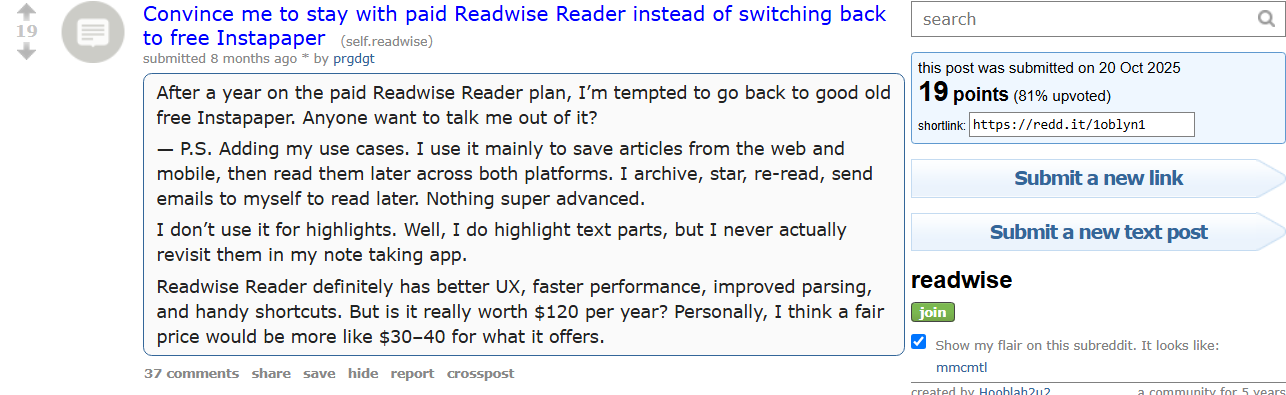
The honest limits are two. First, the default daily experience is passive resurfacing, and Mastery is a layer you opt into and set up yourself. Second, and more fundamental, it works on highlights you already made. It does not read a whole article or watch a video and build the recall for you, and it is not a game. The recurring gripe on Reddit is price, roughly $120 a year for the full bundle with Reader, plus the discipline of highlighting as you go.
Matter and Notion: great tools, wrong job
We include these two because people land on them expecting memory help, and it is fairer to say plainly what they are for. Matter is a lovely read-later app with the best audio in this set, so it will read your articles and newsletters aloud, and its free tier is generous. But it has no recall engine, no spaced repetition, nothing that tests you. It helps you consume, not remember.
Notion is the flexible filing cabinet, and a good one, with a generous free tier. It will store and organize everything you throw at it. What it will never do is make you remember any of it. There is no quizzing, no scheduling, no recall. You are the librarian, and the books do not read themselves back to you.
What people on Reddit actually recommend
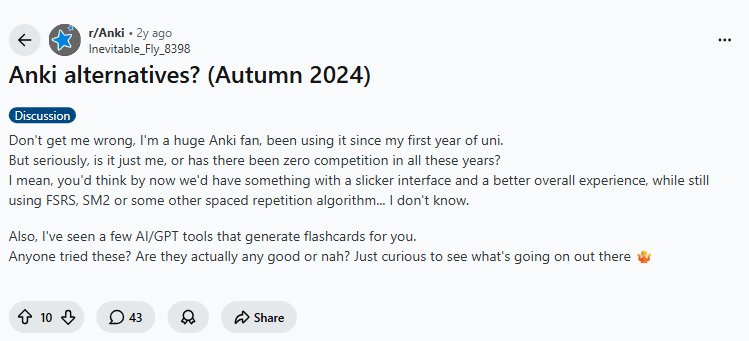
We read the threads before writing this, and the consensus is consistent. Anki is the reflex recommendation for anyone who wants free and deep, and the pushback when someone wants to switch is almost always a genuine question: what specifically about Anki is not working for you? The single most common answer is the manual card-making. On Readwise, the recurring debate is whether the all-in-one experience is worth roughly $120 a year.
There is also a large, thoughtful camp that pushes back on the whole premise: read to learn now, they argue, and stop stressing about remembering every detail. We think that is a fair point, and it is partly why REPS is built to feel like play rather than an obligation. You are not failing a system if you miss a day.
A few real threads worth reading yourself:
- Anki alternatives? (Autumn 2024) r/Anki
- Which is the best free alternative for Anki? r/languagelearning
- Convince me to stay with paid Readwise Reader r/readwise
These are real, unedited threads. We screenshot them and link them so you can read the full discussion and judge the consensus yourself.
Frequently asked questions
Does spaced repetition actually work?
Yes. Spaced repetition is one of the most reliable findings in the science of memory. Instead of cramming, you review something at widening intervals, timed to just before you would forget it. Each well-timed review strengthens the memory and pushes the next review further out. Pair it with active recall, where you retrieve the answer from memory rather than rereading it, and it is the most effective way most people have to hold onto what they learn.
Is Anki the best spaced repetition app?
For depth of algorithm and control, Anki is hard to beat, and it is free on most platforms. It runs SM-2 and the modern FSRS scheduler, has a huge library of community decks, and handles enormous collections. The catch is that you build every card yourself and the interface is dated. If you want maximum control and free, Anki is the answer. If the card-making is what stops you, that is the reason to look elsewhere.
What is the best spaced repetition app if you hate making flashcards?
This is the exact gap REPS was built for. You save an article, a video, or a podcast, and REPS turns it into recall questions for you, then schedules them with spaced repetition. Readwise Mastery is another option if your knowledge already lives in highlights, since it turns your saved highlights into recall on a schedule. Both spare you the manual deck-building that makes people quit Anki.
What are the best free spaced repetition options?
Anki is free on Windows, macOS, Linux, and Android, with paid one-time iOS access that funds the rest. Notion has a generous free tier but no spaced repetition or recall testing, so it organizes rather than tests. Matter has a generous free tier for saving and listening, but no recall engine. REPS is free to join in early access. If free is the only requirement, Anki is the deepest free tool by a wide margin.
Can spaced repetition work with articles, YouTube, and podcasts?
It can, but most tools do not do it for you. Anki needs you to build the cards. Readwise works from highlights you make while reading. REPS is built around it: save what you read, watch, or hear, and it generates the recall questions and schedules them, so the source material itself becomes the spaced repetition, no card-making required.
How to choose
- Want the deepest scheduling for free, and will make cards? Use Anki. Nothing beats it on the algorithm.
- Live inside your highlights and want recall on top? Use Readwise, with Mastery turned on.
- Mostly want to read and listen beautifully? Use Matter, and pair it with a recall tool.
- Just need one place to organize everything? Use Notion, and remember it will not test you.
- Want to remember what you save without building anything, and enjoy it? That is REPS. Save it, play it, keep it.
Start remembering what you read.
Save anything. REPS turns it into quick games that make it stick. Join the waitlist and we will email your invite.
Invite-only early access. One email when your invite is ready. No spam.
