REPS vs Readwise: which one actually makes it stick?
 By Mike McGraw, founder of REPS · Updated July 2026 ·
7 min read
By Mike McGraw, founder of REPS · Updated July 2026 ·
7 min readIf you want to actually remember what you read, watch, or hear, REPS is our pick: you save anything and it builds the recall for you, then serves it back as a quick daily game, no highlighting required. Readwise is the more established, more complete tool, and it is the stronger choice if you want one polished inbox to read and highlight and the widest highlight sync in the category. Reader is the better reading app; REPS is the better remembering habit.
 REPS
REPS
 Readwise
Readwise and REPS get lumped together because both promise you will keep what you learn. But they solve different halves of the same problem. Readwise is built around the highlight: you read, you mark the good parts, and it makes sure those parts come back. REPS is built around the source: you save the whole thing, and it figures out what is worth remembering so you never have to highlight at all. Which one fits depends on how much of the work you want to do yourself.
Where Readwise winsWhere Readwise genuinely wins
We will start here, because it is the honest place to start. Readwise is the more mature, more complete product, and for a large group of people it is the right answer.
- Highlight sync breadth. Readwise pulls highlights from Kindle, Instapaper, Apple Books, Twitter, PDFs, and more into one place, and syncs them out to Notion, Obsidian, Roam, and Evernote. Nothing in this category has a deeper ingestion and export network. If your knowledge already lives across those tools, that is a real, hard-to-replace advantage.
- Readwise Reader, the all-in-one inbox. Reader is one place for articles, PDFs, EPUBs, newsletters, RSS, tweets, and YouTube with transcripts. It is genuinely one of the best reading surfaces built, and REPS does not try to be a reading inbox at all.
- It really does test recall. This is the part most comparison pages get wrong, so we will be clear: Readwise has active recall. Its Mastery feature turns your highlights into recall questions and cloze prompts on a spaced schedule. Readwise does not "just resurface highlights." If you make good highlights, Mastery works on them.
- Maturity. Years of iteration, a large user base, and an integration ecosystem you can lean on. REPS is newer, in invite-only early access. Fewer years means fewer edges sanded down.
Where REPS wins
The gap REPS was built to close is not "Readwise cannot help you remember." It is that Readwise's memory layer runs on the highlights you already made, and making good highlights, consistently, on everything worth remembering, is itself a discipline most people do not keep.
- Done for you, no highlighting required. With REPS you save the source, an article, a book, a YouTube video, a podcast, and it pulls out what is worth remembering and builds the cards for you. No highlighting habit to maintain, no decks to make by hand. You save; REPS makes the cards and does the rest.
- Remembering is a game, not a queue. Readwise's daily experience is a review. REPS's is a set of quick daily games built from what you saved: recall challenges, a crossword, Friends Trivia. Same underlying spaced repetition, delivered as play rather than homework. It is the difference between something you keep up and something you keep avoiding.
- Read, watch, and hear, not just what you highlighted. REPS treats a saved podcast episode or a YouTube video the same way it treats an article: it finds what matters and turns it into recall. Your memory layer covers what you consume, not only the passages you remembered to mark.
- The Second Brain graph. Everything you save becomes a living map of your knowledge, so ideas from different sources connect instead of sitting in separate lists. It is a way to see what you know, not just review it.
- Voice and posture. REPS is deliberately calm and no-guilt: a positive alternative to doomscrolling, not another app that shames you for forgetting. And our pricing intent leans generous, so remembering what you save is not gated behind a premium reading suite.
REPS vs Readwise, feature by feature
Honest checkmarks in both directions. "Reader" refers to Readwise Reader, which is bundled into the Readwise Full plan.
| What matters | REPS | Readwise (+ Reader) |
|---|---|---|
| Best at | Remembering anything you save, as a game | Reading, highlighting, and syncing highlights everywhere |
| Tests your recall | Yes, daily games from your saves | Yes, Mastery on your highlights |
| Does the work for you | Yes, no highlighting or card-building | You highlight; Mastery uses what you mark |
| Read-it-later inbox | No, you read where you already do | Yes, Reader is best-in-class |
| Highlight sync in and out | Not a highlight-sync tool | Yes, the deepest network in the category |
| Covers video and audio | Yes, YouTube and podcasts, same as articles | Reader handles YouTube transcripts |
| Feels like play | Yes, games and challenges | A review, not a game |
| Knowledge graph | Yes, the Second Brain graph | Lists and folders, not a graph |
| Maturity | New, invite-only early access | Mature, established ecosystem |
| Price | Early access, pricing not yet final | ~$5.59/mo Lite, $9.99/mo Full (annual); 30-day trial |
Readwise pricing reflects its live pricing page: Lite around $5.59 per month billed annually (review plus highlights, no Reader), Full at $9.99 per month billed annually or $12.99 monthly (adds Reader). No permanent free tier; there is a 30-day trial and a 50% academic discount by email. REPS is in early access, so its price is not yet set.
From the communityWhat people on Reddit actually say
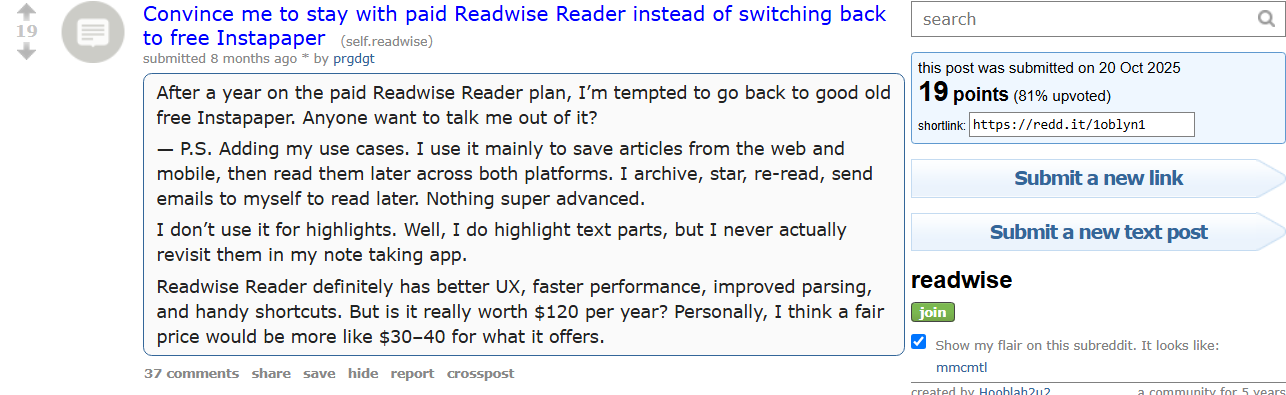
We read the threads before writing this, and we are not going to invent quotes. The recurring, well-attested pattern around Readwise is not about quality. Almost nobody argues Reader is bad; the widely repeated line is closer to "best all-in-one, but overpriced." The two friction points that come up again and again are price, the "is it really worth around $120 a year?" question, and import and highlight friction, the setup and upkeep of getting everything flowing and marking it well.
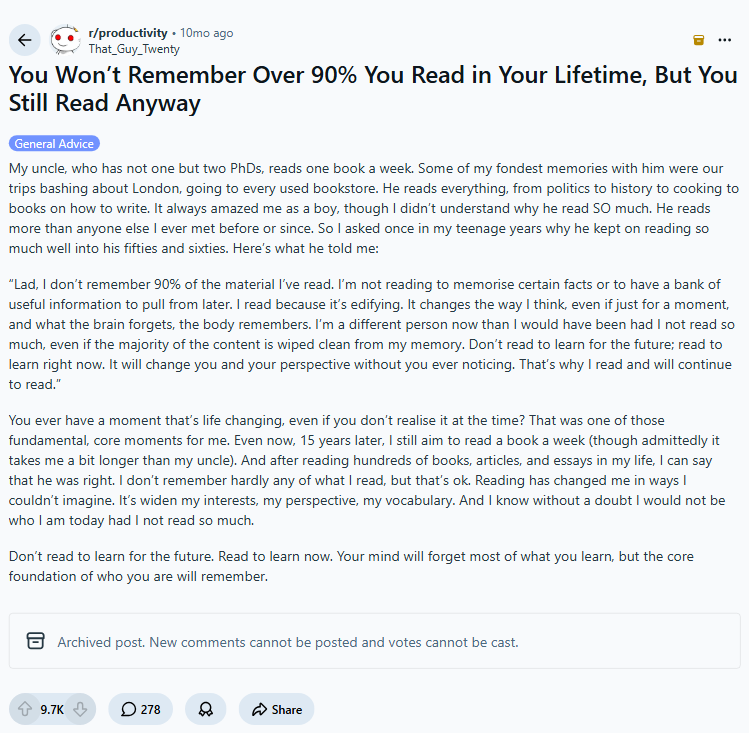
There is also a quieter camp worth naming, because a fear-based memory pitch talks straight past it: plenty of thoughtful readers argue that chasing perfect recall is overrated, that you read to think now and the parts that matter tend to stay. We do not think that is wrong. REPS is built for people who want to remember more without turning it into a second job, and who would rather it feel like a game than a chore. If you are firmly in the "read and move on" camp, you may not need either app.
Some real, on-topic threads if you want to read the room yourself:
- r/readwise, "Convince me to stay with paid Readwise Reader" (the $120-a-year question, in the users' own words)
- r/books, "How to retain what you've read for longer durations"
- r/productivity, "You won't remember over 90% of what you read" (the read-to-learn-now camp shows up strong here)
These are real, unedited threads. We screenshot them and link them so you can read the full discussion and judge the consensus yourself.
The verdictThe verdict: choose the one that fits how you work
Choose Readwise if...
- You want one polished inbox to read, highlight, and organize.
- Your highlights already live in Kindle, Instapaper, or Apple Books and you want them synced everywhere.
- You genuinely enjoy highlighting and want recall on the passages you chose.
- You value a mature, established product with deep integrations.
Choose REPS if...
- You want to remember what you save without highlighting or building anything.
- You read, watch, and listen, and want all of it covered, not just articles you marked up.
- You would actually keep a habit that feels like a game instead of a review queue.
- You want to see your knowledge connect in a Second Brain graph, calmly, with no guilt.
And if you are torn: you can run both. Use Readwise Reader as your reading inbox and REPS as the thing that makes it stick. They are not mutually exclusive, and for a certain kind of heavy reader that stack is close to ideal.
Quick pickerStill deciding? Here is the quick way to pick
Readwise Reader. It is the best all-in-one place to read and highlight, and REPS does not try to be one.
Readwise. Mastery runs real active recall on the passages you mark, synced across your tools.
REPS. Save anything, skip the highlighting, and let it turn what you saved into recall automatically.
REPS. A quick daily game beats a daily review queue for the habit that actually lasts.
Frequently asked
Is REPS a Readwise replacement?
For some people, yes; for others, no. If you live inside Readwise Reader as your reading inbox and you sync highlights from Kindle, Instapaper, and Apple Books, REPS does not replace that. REPS replaces the part where you are supposed to remember what you saved. If your goal is to actually recall what you read, watch, and hear, without building anything by hand, REPS can stand on its own.
Does REPS have a reader or highlighting like Readwise Reader?
No. REPS is not a read-it-later inbox and it does not ask you to highlight. You read, watch, and listen wherever you already do, then save the source into REPS in two taps. REPS pulls out what is worth remembering and turns it into recall for you. Readwise Reader is the better tool if you want one place to read articles, PDFs, EPUBs, and newsletters.
How much does Readwise cost versus REPS?
Readwise offers a Lite plan around $5.59 per month billed annually with the review layer but no Reader, and a Full plan at $9.99 per month billed annually ($12.99 monthly) that adds Reader. There is no permanent free tier, and there is a 30-day trial. REPS is in invite-only early access, so pricing is not final; the design intent is a generous posture where remembering what you save is not paywalled behind a premium reading suite.
Can I use both REPS and Readwise?
Yes, and plenty of people probably will. Readwise Reader is an excellent reading and capture inbox, and its Mastery feature turns your highlights into active recall. REPS handles the remembering side across everything you consume, including YouTube and podcasts, as a daily game. Using Reader to read and REPS to remember is a reasonable stack.
Does REPS do spaced repetition like Readwise Mastery?
Both use spaced repetition, the technique of resurfacing something right before you would forget it. Readwise Mastery runs active recall on the highlights you made. REPS generates the recall for you from the source you saved, so there is no highlighting discipline or card-building required, and it is delivered as quick daily games rather than a review queue.
I started building REPS after realizing I could not remember most of what I read. I use the apps on this list myself, and I write these comparisons to be the honest rundown I wish I had had.
Start remembering what you read.
Save anything. REPS turns it into quick games that make it stick. Join the waitlist and we will email your invite.
Invite-only early access. One email when your invite is ready. No spam.
